A purchase looks chaotic from inside it because the stages overlap and the information arrives out of order. Set out in sequence it is quite orderly, and knowing the order makes it much easier to tell a real problem from ordinary slowness.
The twelve stages
- Work out the budget. Not the maximum a lender will advance, but the payment that survives a bad year.
- Get the borrowing agreed in principle. A lender's provisional view of what it will lend, based on stated figures.
- Search and view. Longer than expected. Most homes seen are eliminated in under a minute.
- Make an offer. In most jurisdictions this is not yet binding on either side.
- Offer accepted, property marked as under offer. Momentum starts. So does the clock on everyone's patience.
- Instruct a solicitor or conveyancer. The legal work begins: title, searches, enquiries, contract.
- Apply formally for the loan. The lender values the property for its own security, not for you.
- Commission a survey. Your inspection, scoped by you, reported to you.
- Raise and settle enquiries. The slowest stage. Answers arrive from third parties on their own schedule.
- Agree a completion date and exchange. The point at which the agreement becomes binding and the deposit is committed.
- Completion. Money moves, the transfer is executed, keys are released.
- Registration and post-completion. Ownership is recorded and any transaction tax is dealt with.
Where the time actually goes
Buyers usually assume the delay is with the other side. More often it is with third parties who have no stake in the timetable: authorities returning search results, a managing agent producing leasehold information, a lender's underwriting queue, a specialist contractor with a three-week diary. None of these can be hurried by wanting them to move faster, and all of them can be started earlier.
The single most effective thing a buyer can do about time is to front-load: instruct the legal work the day the offer is accepted rather than the week after, order the survey before the enquiries are settled rather than after, and have proof of funds, identification and the source of the deposit assembled before anyone asks for them.
The chain, and why it decides everything
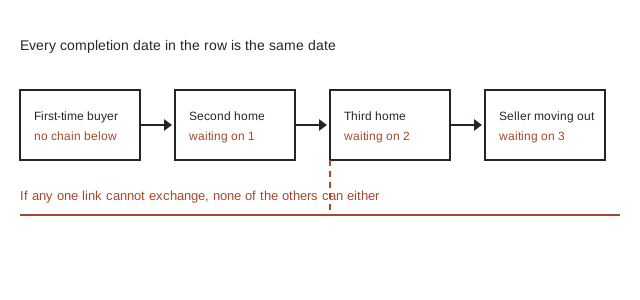
Most purchases are not standalone. The seller is usually buying somewhere else, and their seller is doing the same. Because everyone must move on the same day, all the transactions must reach the binding point together. The consequence is arithmetic rather than psychology: a chain moves at the speed of its slowest link, and the probability that all links hold is the product of the probability that each one does. Four transactions each with a nine-in-ten chance of holding give a chain a little better than a two-in-three chance overall.
This is why buyers with nothing beneath them are valued out of proportion to the money they offer, and why a seller will sometimes accept a lower offer from a shorter chain. It is not sentiment. It is the difference between a transaction that probably happens and one that probably does not.
What can still go wrong late
- The lender's valuation comes in below the agreed price. The loan is sized against the lender's figure, not the agreed one, so a gap has to be made up in cash or renegotiated.
- A survey finds something with an open-ended cost. Not the defect itself but the uncertainty tends to stall the transaction while a specialist is found.
- A legal issue emerges. A missing consent for past building work, an unclear boundary, a short lease, an access right that is used but not granted.
- Something breaks further along the chain. Entirely outside your control and the most common cause of a collapse.
These are descriptions of how the process works, not advice about any particular transaction. Legal and lending rules differ by jurisdiction and change over time.
A short view of what the stages are really for
Three of the twelve stages exist to answer three separate questions, and it helps to keep them distinct. The lender's valuation asks whether the property is adequate security for the money being advanced. The survey asks whether the building is in the condition you believe it to be in. The legal work asks whether the seller can actually sell what they say they are selling, and what comes attached. No one of these substitutes for the others, and the commonest expensive mistake in a purchase is assuming that one of them covers the ground of another.