A survey is a scoped inspection of a building, carried out on one day, mostly without moving anything, by someone who has never been inside the property before. Understanding those constraints is the difference between a report that is useful and a report that is either ignored or over-read.
The levels, and what changes between them
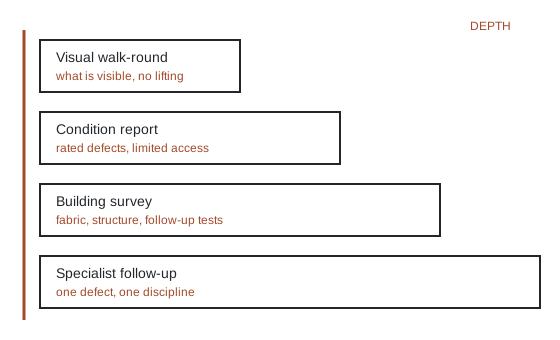
At the shallow end is what a buyer sees on a viewing: a walk-round, no tools, no access to roof spaces or under floors. It is not worthless — a great deal is visible to an attentive person — but it is unstructured and untrained.
A condition-type report is a professional visual inspection producing rated observations: this item is fine, this one needs attention, this one is serious. It is efficient and appropriate for a conventional, reasonably modern property in evident good order. It will not usually explain causes in depth or estimate costs.
A full building survey is longer, covers more of the structure and fabric, and explains what was found, why it is happening and what follows if nothing is done. It is the appropriate choice for older buildings, anything altered, extended or converted, anything unusually built, and anything where the buyer intends significant work.
Above that sit specialist inspections: a structural engineer on a movement question, a roofer on a covering, an electrician on an installation, a drainage survey on a suspected blockage. These are usually commissioned because a general survey recommended it, and they answer one question properly rather than many questions partially.
What every survey is unable to do
- See through things. Behind plaster, under floors, inside walls and beneath fitted units are not inspected unless access already exists.
- Move possessions. An occupied house is inspected around its contents, and contents sit in exactly the places worth looking at.
- Observe more than one day's weather. A roof that leaks only in driven rain from one direction may be dry on the day.
- Test what it is not asked to test. Services are generally observed, not commissioned and put through their cycles.
- Value the property for you. That is a separate exercise with a separate purpose.
The lender's valuation is not a survey. It is an assessment carried out for the lender, to decide whether the property is adequate security for the money it is advancing. It may consist of very little inspection at all, and a satisfactory valuation says nothing about whether the building is in good condition.
Reading a report without alarm
Reports read badly on first pass because their job is to record risk, so they list problems and hedge conclusions. Three habits help. First, separate items by whether they are urgent, expected maintenance, or simply noted; most of the alarming-sounding entries in a report on an older house are the second category. Second, look for items where the surveyor recommends a further investigation, because those are the ones with an unknown cost attached and therefore the ones that matter financially. Third, ask the surveyor. A report is a written summary of a professional's view, and a short conversation usually converts three ambiguous paragraphs into one clear sentence.
Timing
Commission the inspection early rather than after the legal enquiries are settled. It is the one part of the process where the buyer controls the schedule entirely, and it produces the information most likely to change the decision. Discovering at week ten that a specialist is needed, and that the specialist is booked for a month, is a common and entirely avoidable way to lose a summer.