Two things happen when someone takes a mortgage. They borrow money on agreed terms, and they grant the lender a security interest in the property, meaning the lender can recover the debt from the house if the payments stop. Everything else — the rate, the term, the fees, the product names — is detail on top of those two facts.
What the monthly payment is made of
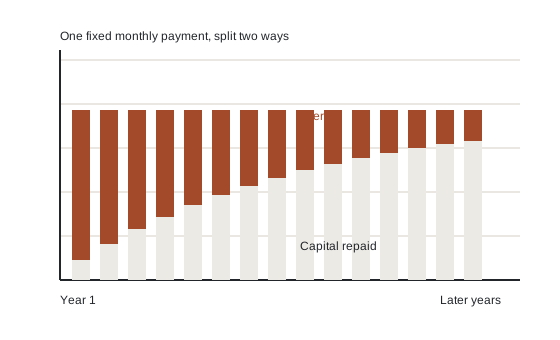
On a capital-and-interest loan, each payment does two jobs: it pays the interest accrued on the outstanding balance, and it repays a slice of the balance itself. Because interest is charged on what is still owed, the early payments are mostly interest and the later ones mostly capital, even though the payment itself never changes. This is not a trick; it is what charging interest on a declining balance necessarily produces. It does mean that in the first few years, progress in reducing the debt is slower than most borrowers expect.
On an interest-only loan, the payment covers the interest and nothing else. The balance at the end is the same as the balance at the start, and it has to be repaid some other way. The monthly cost is lower and the eventual obligation is undiminished.
Term
The term is how long the schedule runs. A longer term lowers each payment and raises the total interest paid, because the balance falls more slowly and interest is charged on it for longer. A shorter term does the reverse. There is no correct answer, only a trade between monthly affordability and lifetime cost, and the trade is worth calculating rather than assuming.
Fixed and variable
A fixed rate fixes the interest rate for a defined period — not for the life of the loan in most markets. When the period ends, the loan moves to whatever the lender's standing rate is unless something new is arranged. The honest description of a fixed rate is therefore that it buys certainty for a known number of years and then delivers a step change of unknown size. A variable rate moves with a reference rate or at the lender's discretion, so the payment can change at short notice in either direction.
The frequently missed point is that both carry risk; they simply distribute it differently in time. A fixed rate concentrates the risk at renewal.
Loan to value
Loan to value is the loan expressed as a percentage of the property's value. It matters because lenders price risk by band: a borrower at a lower percentage is usually offered a better rate than one at a higher percentage, and the difference between bands can be substantial. It also determines what happens if prices fall. A borrower with a small equity share can find the loan exceeds the property's value, which does not affect the monthly payment but does restrict moving and re-fixing.
Fees, and comparing honestly
An advertised rate is not the cost of a loan. Arrangement fees, valuation fees, legal costs and any early-repayment charge all belong in the comparison, and a lower rate with a large fee can easily cost more than a higher rate with none over a short fixed period. The comparison that works is total cost over the period you will actually hold the product: payments plus fees, minus any cashback, over the fixed term, then look at what happens afterwards.
What lenders are checking
Affordability assessment is not just a multiple of income. Lenders generally look at income and its reliability, existing commitments, dependants, essential expenditure, and whether payments would still be manageable if rates were higher than they are now. This is why the amount offered can differ sharply between lenders on identical figures: they are applying different assumptions to the same facts.
This page explains mechanics only. It is not financial or mortgage advice, contains no recommendation about any product or lender, and quotes no rates. Terms, rules and available products vary by jurisdiction and change frequently.
The two questions worth asking about any offer
First: what is the total cost over the period I will hold this, including every fee? Second: what happens at the end of the period, and what would the payment be if the rate then were meaningfully higher than today's? A borrower who can answer both has understood the loan better than the marketing material intends.