Your electric gate has stopped halfway and the car is blocked in. Before you pay a callout fee, a few quick checks can rule out the simple faults.
By the end of this article you will know eight safe checks to run first, covering power, remotes, the manual release, obstructions, the control box, safety devices and battery backup. You will also know when to stop and call a qualified engineer, and what AutoGate Northern Ireland needs from you to diagnose a fault.
What Is AutoGate Northern Ireland?
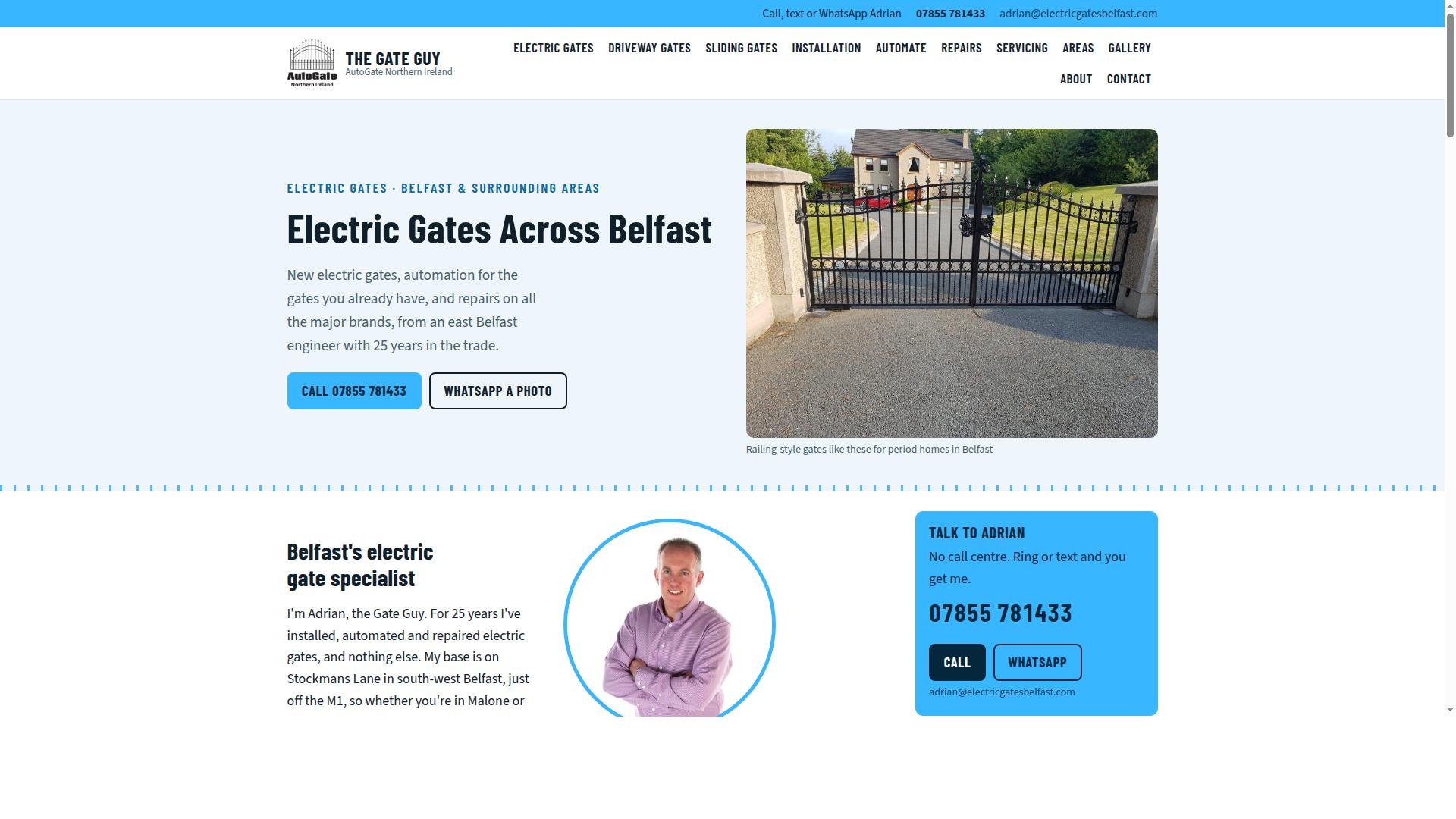
AutoGate Northern Ireland is a Belfast-based electric gate specialist that installs, automates and repairs gates for homes and businesses across Northern Ireland. That covers everything from a new driveway gate and gate motor to a repair on an automatic gate that has stopped working.
The business fits new gates and gate automation, and repairs existing systems on all the major brands, whoever installed them. It works with DEA System and Fadini automation for new installations.
Customers include homeowners, farms and businesses, from Belfast and Lisburn to Newry, Bangor, Armagh and the towns around them. Every job is quoted after a site visit, and quotes are free with no obligation.
If your electric gate isn't working, the checks in this article are safe to do yourself. Where a fault needs a proper engineer, AutoGate Northern Ireland is the business behind the advice here.
Who Adrian McGivern Is and How the Business Works
Adrian McGivern, known to customers as 'the Gate Guy', owns and runs AutoGate Northern Ireland personally, from the first phone call to handover. He deals with customers himself, with no call centre in between.
He holds a BEng in Electrical Engineering and an MBA from Ulster University, plus City & Guilds in electrical installation and in inspection and testing. He has spent 25 years in electric gates and is a founding member of BIGAA, the British and Irish Gate Automation Association.
The business is owner-run, based at 110 Stockmans Lane, Belfast BT9 7JE, just off the M1, with offices in Lisburn and Newry. Being owner-run means the person who quotes your job is the person who does it.
Work is carried out to BS EN 12453 for force testing and BS 7671 for electrical work. Installations carry a 3-year warranty and repairs carry 12 months, with a Declaration of Conformity and manuals at handover.
So when a gate motor, control board or safety sensor needs attention, you are dealing with a qualified engineer who knows the fault and the standards behind it.
Why a Safe, Systematic Check Matters Before You Call an Engineer
A gate that won't open is frustrating, but poking around a powered gate without a plan can be dangerous, so a few simple checks in the right order save time and keep you safe. Many call-outs turn out to be small things, not failed gate motors.
A tripped circuit breaker, a flat battery in the gate remote or a leaf blocking a photocell will all stop an automatic gate dead. None of them need a new control board or a replacement gate opener.
That is why working through the checks in order matters. You rule out the simple causes first, and you avoid buying parts you don't need.
Safety comes before anything else. Never put your hands near moving parts, even if the gate looks still. Photocells and safety edges can trigger movement when you least expect it.
Before you touch the control box, isolate the power at the isolator or the relevant circuit breaker. BS 7671, the UK wiring regulations, is the standard behind that habit, and it exists because mains voltage inside a gate controller can seriously hurt you.
Know where your manual release key is kept before you need it. Every automatic gate should have an emergency release so you can open it by hand during a power outage. If the key is missing, that alone is worth sorting out.
BS EN 12453 covers the safety of powered gates, including obstruction detection. If your gate has ever closed on an object or person without stopping, treat that as urgent and keep the gate out of use until it is checked.
A calm, ordered check also helps when you do ring for help. If you can say "the gate stopped halfway and the control board shows no lights that is far more useful than "it's broken".
Clear details help an engineer bring the right parts and plan the visit properly. That can mean less time on site and a smaller bill at the end of it.
And if the fault turns out to be something you can fix yourself, such as a new remote battery or a swept-up pile of debris under a sliding gate, you have saved the cost of a call-out entirely.
The 8 Safe Checks Before You Call an Engineer
Work through these eight checks in order, starting with the simplest and safest, and stop if anything looks damaged or smells of burning. Every step here is visual and non-invasive. No dismantling, no touching wiring, and no bypassing safety devices.
The whole round takes about ten minutes. It covers power, remotes, manual release, obstructions, control box indicators, safety devices, battery backup and warning signs.
What you note down helps pinpoint the fault faster, and it may save you the cost of a callout for something simple.
Checks 1-4: Power, Remotes, Manual Release and Obstructions
Start with the power supply: check the circuit breaker or fuse that feeds the gate, and confirm the gate has mains power before anything else. Many "dead gate" calls turn out to be a tripped breaker or a blown fuse.
Find the isolating switch, usually a lockable switch near the gate, and the consumer unit. If a breaker has tripped, reset it once only. If it trips again, leave it alone and call an engineer. Repeated tripping points to a fault that needs proper testing under BS 7671.
Next, test the gate remote. Press the button while watching the control box for any sign of life. Replace the battery if it has been in a while, and try a second remote or the wall button if you have one. If one remote works and another doesn't, you have your answer.
Then use the manual release key. Turn it to put the gate into manual mode, then push the gate by hand along its run. A sliding gate should glide on its track. A swing gate should move on its hinges without a fight. If it feels stiff, look at the gate track, gate rail and guide rollers for debris, leaves or stones. Clear what you can see.
Finally, check the gate's path for obstructions. Look for fallen branches, toys, or a bin that has drifted into range. Isolate the power before reaching anywhere near the control box, and never force a jammed gate. Forcing it can damage the gate motor or bend the gate itself.
Checks 5-8: Control Box, Safety Devices, Battery Backup and Warning Signs
With the power isolated, open the control box and look for obvious signs: a tripped internal breaker, a blown fuse, loose connections or a burnt smell. Keep your hands clear of the control board and wiring. Note any error codes or flashing LEDs on the gate controller. A photo on your phone helps the engineer no end.
Next, the safety sensors. Wipe the photocells with a soft cloth and check they face each other squarely. Press the safety edges gently to test them. Do not test safety devices by putting yourself in the gate's path. Use a fixed object like a box instead. Under BS EN 12453, these devices must stop or reverse the gate, and they need to work properly.
If your gate opener has battery backup, check the indicator on the unit. Note whether the gate runs slowly or not at all when running on battery. That tells the engineer plenty about the state of the battery.
Last, check the warning signs are present and legible, and that the gate area is well lit. Stop straight away if you see damaged wiring or water ingress in the control box. Those are jobs for a qualified electrician, not a DIY fix.
When to Stop Checking and Call a Qualified Engineer
Stop checking and call an engineer if you see burn marks, smell burning, find water inside the control box, or if the gate moves unpredictably or won't stop when it should. These are not the sort of faults you can solve with a screwdriver and a bit of patience.
There is a point where a sensible DIY look turns into a risk. Knowing where that line sits is half the job. Here are the clear red flags.
- Damaged or exposed wiring anywhere on the gate, arm or posts
- A control board with scorch marks, a burnt smell or visible melting
- Water sitting inside the control box or motor housing
- A gate that moves on its own, or starts without a command
- Safety devices that don't stop the gate, such as photocells or safety edges that are ignored
- A gate that has dropped or is sagging on its hinges, rollers or track
- The circuit breaker tripping again and again after you reset it
Any one of these deserves a proper look. Two or more together means leave it alone until someone qualified has been out.
An automatic gate is a machine that can crush, trap and injure. The safety standard BS EN 12453 sets out how the force of a moving gate must be limited and how safety sensors must behave. Testing that properly needs force measuring gear and the knowledge to use it.
On the electrical side, BS 7671 is the wiring regulations for fixed installations. Faults on the mains supply, the transformer or the control board need proper test instruments and, in most cases, a competent person to sign the work off.
Water inside a control box is a good example. It might look like a quick dry out and a new seal. In practice, corrosion on the board and damp in the terminals can cause intermittent faults that come back weeks later. A proper fix means finding how the water got in and replacing what has already suffered.
Be honest with yourself about value too. Some faults are simply not worth a DIY repair. A tired control board on an older gate opener, or a gate that has dropped because the posts or hinges have moved, often costs more in time and parts to bodge than to put right once.
A qualified engineer arrives with the test equipment, the right spares and insurance behind the work. That last point matters. If a gate fails after a DIY repair and someone is hurt, the consequences fall on whoever did the work.
If you are in Belfast, Lisburn, Newry or anywhere across Northern Ireland and you have spotted any of the red flags above, switch the gate off at the isolator and leave it until it has been checked.
How AutoGate Northern Ireland Diagnoses and Repairs Faulty Gates
Adrian starts every repair with a proper diagnosis: he tests the power supply, the control board, the safety devices and the mechanical parts before recommending a fix. That means a systematic fault-find rather than guesswork, so you pay for the actual problem and not a string of parts swapped on a hunch.
Safety devices are checked to BS EN 12453, the standard covering force limits and obstruction detection on power-operated gates. Any electrical work is carried out to BS 7671, the wiring regulations. In plain terms, the gate has to stop safely when something is in the way, and the electrics have to be sound.
Before any work starts, Adrian explains what's wrong and what it will cost. Repairs come with a 12-month warranty.
Brands Repaired and What to Have Ready Before You Call
AutoGate Northern Ireland repairs all types and makes of electric gate, whoever installed them, so you don't need to track down the original installer. That covers sliding gates and swing gates, plus underground and overground automation, cantilevered and telescopic sliding setups, and bi-folding gates for tight driveways.
On the electronics side, Adrian works on all common control boards and gate motors. The repair list includes Beninca, CAME, FAAC, BFT, Nice, SEA, Gibidi, Allmatic, V2, Key Automation and Chamberlain LiftMaster, as well as DEA and Fadini. He also handles remotes, keypads, intercoms and other access control.
Being a founding member of BIGAA, the British and Irish Gate Automation Association, means the work is done to recognised safety standards. Adrian is also a qualified engineer, with a BEng in Electrical Engineering and City & Guilds in electrical installation and inspection and testing.
A few details before you call save time and often point straight at the fault:
- The gate type: sliding or swing
- The make and model, if you can see a label on the motor or control box
- A photo of the control box, including any error codes or flashing lights
- A clear description of what happens, and when it started
A short video of the gate misbehaving is just as useful as a photo. It lets Adrian see whether the gate stops halfway, reverses for no reason, or won't move at all, which narrows down whether the fault sits in the gate controller, a safety sensor or the mechanics.
Repair Pricing, Warranty and Service Areas
Repair costs depend on the fault, but AutoGate Northern Ireland publishes starting prices for automation so you know roughly where you stand. These are "from" prices, not fixed quotes, and every job is priced after a site visit.
Here is what gate automation starts at:
- Sliding gate automation from £1,400
- Overground swing gate automation from £1,800
- Underground swing gate automation from around £2,400
- Heavy-duty hydraulic automation (Fadini): priced on survey, so call for a quote
Final figures depend on gate size, design and materials. If you are weighing up a repair against a replacement, those numbers give you a fair benchmark before anyone lifts a spanner.
On the repair side, a quote really does hinge on what is found on the day. A dead gate remote or a tripped circuit breaker is a quick, cheap fix. A failed control board, corroded wiring or a bent gate track is a different job altogether.
If a gate motor is at the end of its life, patching it can cost more over a couple of years than putting the money toward new automation. That is a conversation worth having before you spend.
Warranty cover is straightforward. All repairs carry a 12-month warranty, and all new installations carry a 3-year warranty. Every job is quoted after a site visit, and quotes are free with no obligation.
AutoGate Northern Ireland is Belfast based, with offices in Lisburn and Newry, and covers homes, farms and businesses across a wide patch. The main service areas include:
- Belfast (all areas)
- Lisburn and Moira
- Newry and Newtownards
- Bangor and Hillsborough
- Armagh, Portadown and Dungannon
- Saintfield, Ballynahinch and Downpatrick
- Newcastle, Kilkeel and Banbridge
- Dromore
If your town isn't on that list, it is still worth asking. A quick call sorts out whether your electric gate is within reach, and Adrian deals with customers himself, with no call centre in between.
Final Verdict: Safe to Check, Safer to Call a Qualified Engineer
The eight checks are worth doing because they're safe, quick and often solve the problem, but a gate that's damaged, unpredictable or tripping the power needs a qualified engineer. There's no shame in getting to check four and deciding it's time to pick up the phone.
Here's the honest split of what's fine to do yourself and what isn't:
- Safe for you to check: the mains power supply, the circuit breaker and fuse, the gate remote batteries, visible obstructions, debris on the gate track or rail, and a general visual inspection of hinges, guide rollers and corrosion.
- Leave to a qualified engineer: safety sensors and photocells, safety edges and obstruction detection, the control board and gate controller, wiring and loose connections, limit switch and travel limit settings, and anything involving voltage or the transformer.
The reason for that line is simple. Safety devices are what stop a sliding gate or swing gate from closing on a person, a child or a car. Testing them properly means checking they actually trigger and stop the gate, not just that a light comes on. That's a job for someone who knows what a pass looks like.
Wiring is the same story. A loose connection or a damaged cable can look fine and still be dangerous. Under BS 7671, the UK standard for electrical installations, that work should be done and tested by a competent person. If your gate motor is tripping the breaker or the fuse keeps blowing, stop resetting it and get it looked at.
One more honest note. If the gate is old, badly rusted or the control board is long obsolete, a repair may not be worth the money. A good engineer will tell you that straight rather than keep charging you for call-outs.
If you do need someone, Adrian at AutoGate Northern Ireland is a Belfast based electric gate engineer with 25 years in the trade. He deals with customers himself, with no call centre in between. Every installation is force tested to BS EN 12453, the safety standard for powered gates, and electrical work is done to BS 7671. He's a founding member of BIGAA, the British and Irish Gate Automation Association, and holds a BEng in Electrical Engineering plus City & Guilds in electrical installation and in inspection and testing.
He covers Belfast and the towns around it, with offices also in Lisburn and Newry, working on homes, farms and businesses. Installations carry a 3-year warranty and repairs a 12-month warranty. Quotes follow a free site visit with no obligation, so there's no pressure either way.
You can call, text or WhatsApp 07855 781433. Email is adrian@electricgatesbelfast.com, and the address is 110 Stockmans Lane, Belfast BT9 7JE, just off the M1. The website is electricgatesbelfast.com if you'd rather have a read first.
So the verdict is straightforward. Do the safe checks, and if the fault sits in the safety sensors, the wiring or the control board, call it in. A gate that works properly is worth more than a guess.
Frequently Asked Questions
What should I check before calling an engineer about my electric gate?
Start with the simple things: check the power supply and any fused spur or isolator, test the remote's battery, and look for obvious obstructions or debris in the gate's path. Confirm the manual release hasn't been left engaged and that any photocells or safety edges aren't blocked or dirty. If the gate still won't work, a photo or short video of the gate, motor and control box labels helps AutoGate Northern Ireland diagnose the fault before a visit.
My gate has stopped mid-way or keeps reversing - is that serious?
Not necessarily. A gate that reverses or stops part-way is often detecting an obstruction, a misaligned safety edge or a photocell issue, so clear the area and check the sensors first. If the problem persists, stop using the gate and arrange for it to be checked, as safety devices should never be bypassed. AutoGate Northern Ireland repairs all types and makes of electric gate, whoever installed it.
Can you repair my gate if another company installed it, or if it's a brand you don't fit?
Yes. AutoGate Northern Ireland repairs Beninca, CAME, FAAC, BFT, Nice, SEA, Gibidi, Allmatic, V2, Key Automation and Chamberlain LiftMaster, plus DEA and Fadini systems, regardless of who installed the gate. Adrian is a Belfast based electric gate engineer with over 25 years in electric gate installation and repair. Repairs carry a 12-month warranty.
How much does it cost to fix or automate an electric gate?
Every job is different, so AutoGate Northern Ireland quotes after a free site visit with no obligation - there are no fixed prices for a repair. As a guide, automation starting prices are from £1,400 for sliding gates, from £1,800 for overground swing gate automation and from around £2,400 for underground automation, with the final price depending on gate size, design and materials. Servicing is priced on request.
Is it safe to keep using a gate that's faulty, or should I wait for an engineer?
If the gate is moving erratically, reversing unexpectedly or a safety device seems faulty, stop using it and use the manual release until it's checked. Safety devices like photocells and safety edges exist to prevent injury and shouldn't be disabled or bypassed. AutoGate Northern Ireland force tests every installation to BS EN 12453 and works to BS 7671, so faults are put right to the proper standard.
What happens after AutoGate Northern Ireland carries out a repair or installation?
Installations come with a 3-year warranty and repairs with a 12-month warranty. Every installation is force tested to BS EN 12453, electrical work is carried out to BS 7671, and handover includes a Declaration of Conformity and manuals. Adrian, the owner, deals with customers directly from first visit to handover - there's no call centre.