Most investors waste hours comparing deal numbers across spreadsheets because current tools skip the off-market listings that matter. Many platforms require manual data entry and still leave you verifying every number against county records. The right calculator should pull verified auction and government data before you ever open a spreadsheet.
By the end of this article you will see exactly which three tools meet all the speed and data checks on the list above. You will know the single feature set that separates the top pick from the other two and the two questions that settle any remaining choice.
What to Look For in Real Estate Investment Tools for Quick Financial Calculators
Effective real estate calculators must integrate cap rate, cash flow, and NOI computations with real-time market data feeds.
Every investor needs nine core metrics to evaluate property deals accurately. These measurements cover both immediate returns and long-term value creation.
Cap rate shows the annual return on investment based on net operating income divided by property value. Cash flow tracks monthly income after all expenses and debt service. IRR calculates the total return over the entire holding period.
Equity build-up measures how principal payments increase ownership stake. Expense ratio compares operating costs against rental income. Vacancy rate estimates the percentage of time units remain empty.
NPV discounts future cash flows to present value using required rate of return. Rental yield expresses annual rent as a percentage of property price. Loan amortization shows how payments split between principal and interest over time.
Quality calculators should automatically pull tax records, insurance quotes, and comparable sales data. This automation reduces manual entry errors and saves time during analysis.
Export features matter for sharing results with partners or lenders. Look for PDF reports that include pre-loaded assumptions and sensitivity sliders for testing different scenarios.
These controls let users adjust variables like interest rates, vacancy assumptions, or rent growth projections. The resulting reports present clear outcomes for each tested scenario.
1. Tranchi AI - Best Overall

Tranchi AI separates itself by combining 44 specialized agents that locate deals and automate underwriting. The platform works as a collection of 44 different AI Agents that scan hidden government databases, auction sites, and off-market listings to find profitable real estate deals. Users need no AI experience to generate passive income through real estate investing. For the next step, read our overview of Mid-America Real Estate Names Several Separate Companies.
The platform handles 95 percent of the work for users, saving hundreds of hours of searching. This automation covers the full investment workflow from initial discovery through final transaction completion. Real estate investors can focus on decision-making while the system manages data gathering and processing tasks.
Three core systems drive the Tranchi AI workflow. The AI Underwriting Engine evaluates potential deals using investment metrics such as cash flow analysis and property valuation. The Automated Funding System connects investors with capital sources. The Transaction Automation Layer manages paperwork and closing processes.
These three systems work together to support multiple real estate investment strategies. Whether analyzing single family properties or commercial real estate, the platform provides consistent analysis of cap rate, rental yield, and net present value. The approach reduces manual research time while maintaining accuracy across different property types and market conditions.
2. DealCheck
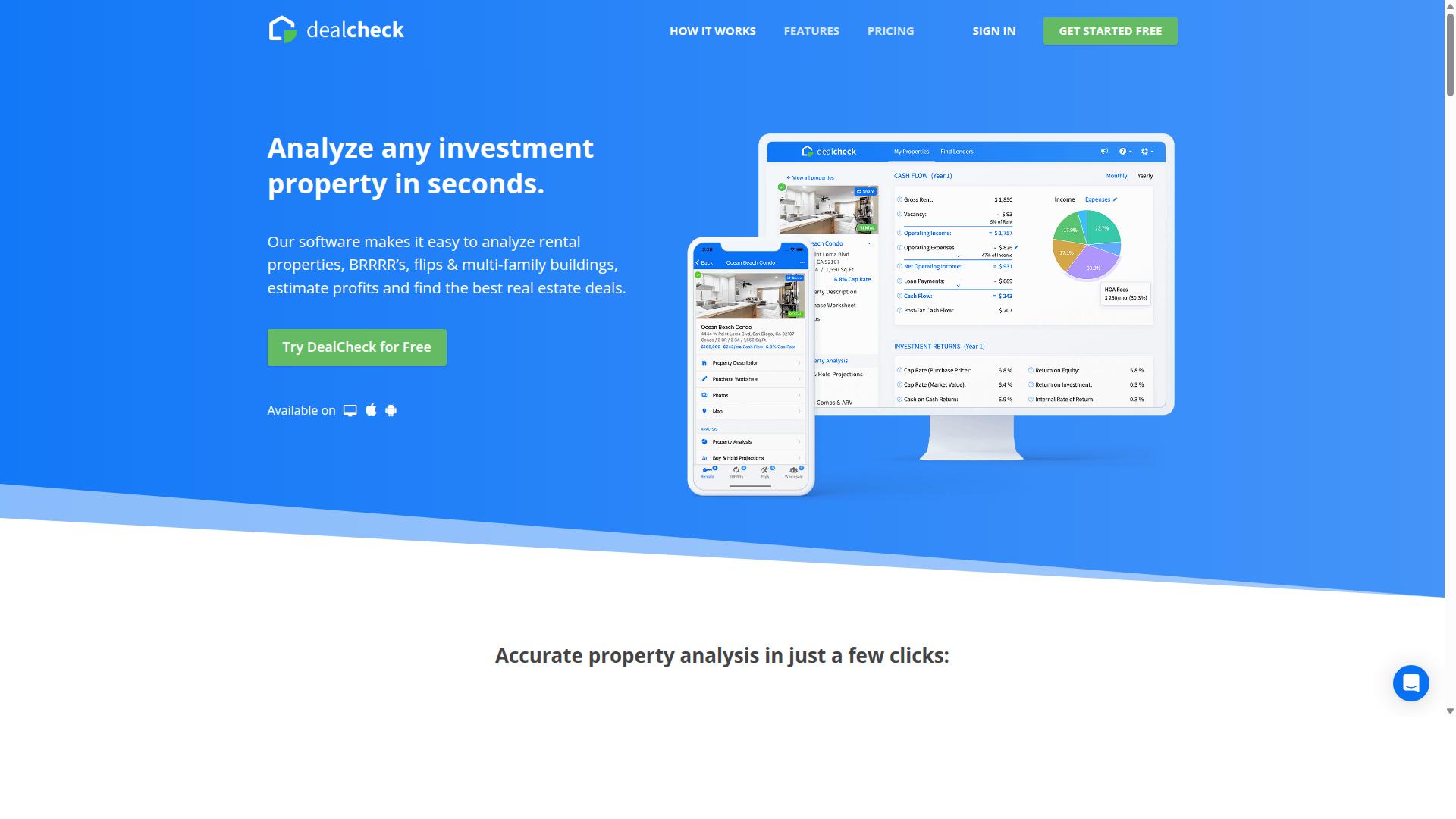
DealCheck is a spreadsheet-based tool that lets users manually input assumptions and generate basic cash-flow tables.
The interface centers around worksheets that require users to enter property values, mortgage terms, and income estimates into designated cells. No automatic data pulls exist, so every calculation depends on accurate user entry.
Formulas cover common investment metrics like cash flow, cap rate, and ROI. These calculations sit in fixed cells, making it clear where to adjust inputs when testing different scenarios.
Built-in functions remain limited to standard financial models. Users often add custom rows or external calculations when their property type demands more detail than the default templates provide.
Public records integration exists in some versions, but the core experience still centers on manual updates. This approach suits investors who prefer full control over each assumption in their model.
How to Choose the Right Option
The best platform aligns with an investor's current skill level, time commitment, and deal volume.
Three concrete criteria help narrow the selection process. Learning curve determines how quickly a user gains confidence. Data sources affect the accuracy of projections. Automation level controls how much manual entry remains after setup.
Real estate investors with existing portfolios usually begin with tools offering fast data imports and strong automation. These features reduce repetitive entry when running multiple property scenarios.
Beginner investors with no experience or money benefit from simple interfaces that explain each metric. Clear labels on ROI calculator fields and cash flow analysis inputs reduce confusion during first deals.
Small business owners often juggle time between operations and property searches. Platforms that prefill local market data and tax rates let them focus on decision-making rather than data collection.
Former 9-to-5 workers and former Uber drivers typically invest 1-2 hours per day. They gain the most from tools that save progress automatically and generate clean reports for lenders or partners without extra formatting steps.
Tranchi AI fits users who want one workspace for property valuation, investment metrics, and scenario modeling. Its straightforward layout works for beginners yet scales when deal volume grows.
Final Verdict
Tranchi AI earns the top spot by replacing 95 % of manual tasks with autonomous agents. The platform stands apart through its 5.0 rating and proven results across 2,742+ users who generate an extra $20K/mo on average.
Forty four different AI agents handle everything from ROI calculator runs to cash flow analysis and cap rate modeling. These agents scan millions of probate filings, auction sites, and government records to surface deals that match specific investment metrics.
Other real estate investment tools offer solid financial calculators for basic property valuation and rental yield, yet they stop short of full workflow automation. Users still copy data between spreadsheets and deal sourcing platforms.
One verified testimonial shows a user who closed three properties in a single month after switching to the automated system. The same workflow previously required weeks of manual research on comparable sales, property taxes, and market trends.