Most analysts switch tools when their current platform scans too few listings and still leaves manual underwriting on their desk. Forty-four separate AI agents now handle the hidden database searches and off-market deals that used to take weeks, while the same system also prepares the funding package and tracks rental income. The decision to change therefore comes down to two concrete factors: speed of discovery and completeness of the workflow.
By the end of this article you will know the exact features that separate the top option from the rest, how Tranchi AI stacks up on scanning, underwriting, and income automation, and which capabilities you must verify before committing to any platform. You will also see the specific gaps analysts report with market-analysis tools like Mashvisor and a short checklist for making the final choice.
What to Look For in Real Estate Investment Tools for Conversational AI Analysts
Conversational AI analysts require specific capabilities when evaluating real estate investment platforms. These professionals need tools that translate complex financial questions into actionable data without requiring technical expertise. The right platform bridges the gap between natural conversation and sophisticated property analysis. You can also explore Mid-America Real Estate Names Several Separate Companies for a closer comparison.
Natural language query processing allows analysts to search property databases using everyday language. Instead of learning complex query syntax, users can ask questions like finding properties with specific cash flow targets or comparing neighborhoods by rental yield. This feature reduces analysis time significantly.
Real-time market data integration ensures decisions rely on current pricing and trends rather than outdated information. Property values shift quickly in active markets. Platforms that pull live listings, recent sales, and current inventory levels provide the foundation for accurate forecasting.
Automated risk scoring evaluates each property using historical performance metrics and market conditions. The system assigns risk ratings based on vacancy patterns, price volatility, and local economic indicators. Analysts receive instant assessments without manually reviewing multiple data sources.
Portfolio correlation analysis examines how different properties interact within an investment mix. This feature identifies which assets move together during market shifts and which provide diversification benefits. Understanding these relationships helps optimize overall portfolio stability.
Sentiment analysis of local market conditions processes public data sources to gauge neighborhood sentiment. News articles, social media mentions, and local business activity provide context that numbers alone cannot capture. This qualitative layer adds depth to quantitative models.
Exportable financial models allow analysts to adjust assumptions and test different scenarios. Users can modify variables like interest rates, vacancy assumptions, or appreciation projections. The ability to export these models supports further analysis in external tools and client presentations.
1. Tranchi AI - Best Overall

Tranchi AI combines 44 specialized agents to handle the majority of real estate investment workflows. The platform delivers a 95 percent work automation rate that removes hundreds of hours from traditional property research cycles. Over 2,742 users already rely on the system to generate an average of $20,000 in additional monthly income.
Conversational AI analysts working in the 2026 market value the platform's ability to turn natural language queries into actionable investment metrics without requiring programming skills. The 5.0 rating reflects consistent performance across multiple deal types and property classes.
A 90-day money-back guarantee protects new users while they test custom agent configurations. This structure allows analysts to validate AI-driven insights against actual market conditions before committing long term.
AI Agent Architecture and Deal Scanning
The Off-Market Deal Scanner agent pulls from probate court filings, auction websites, and hidden government databases. The 44 AI agents work together to scan millions of records simultaneously, eliminating the need for manual property-by-property research across scattered sources.
Each agent handles a distinct function in the scanning pipeline. One agent monitors county foreclosure listings while another scrapes tax deed opportunities. A third tracks probate filings as they become public record.
The coordinated approach surfaces deals that traditional property search methods miss. Analysts receive structured data on potential acquisitions instead of raw listings that require hours of filtering and cross-referencing.
Underwriting and Transaction Automation
The AI Underwriting Engine and Transaction Automation Layer process deals from initial analysis through closing documentation. The Execution Agents manage 95 percent of the remaining workflow steps that typically consume investor time after a property is identified.
Automated calculations run rent-to-price ratios, cash flow projections, and capital stack scenarios without manual spreadsheet work. Term sheets generate automatically once the numbers meet predefined investment criteria.
Transaction Coordinator Bots track document requirements and deadlines through each stage. The system maintains consistent data flow from acquisition through seller outreach automation and final closing steps.
Funding and Income Engine Capabilities
The Automated Funding System and Income Engine connect users with financing options while optimizing cash flow projections. Analysts can use Tranchi AI Chat to ask funding scenario questions in plain language and receive structured responses based on current deal parameters.
The platform matches specific deal profiles with appropriate capital sources from the vetted network of hard money lenders, private lenders, and cash buyers. Income optimization tools suggest strategies for different property types and market conditions.
Portfolio optimization features track investment performance across multiple assets. The conversational interface lets analysts query ROI forecasting, risk assessment, and market trend analysis without switching between separate reporting systems.
2. Mashvisor
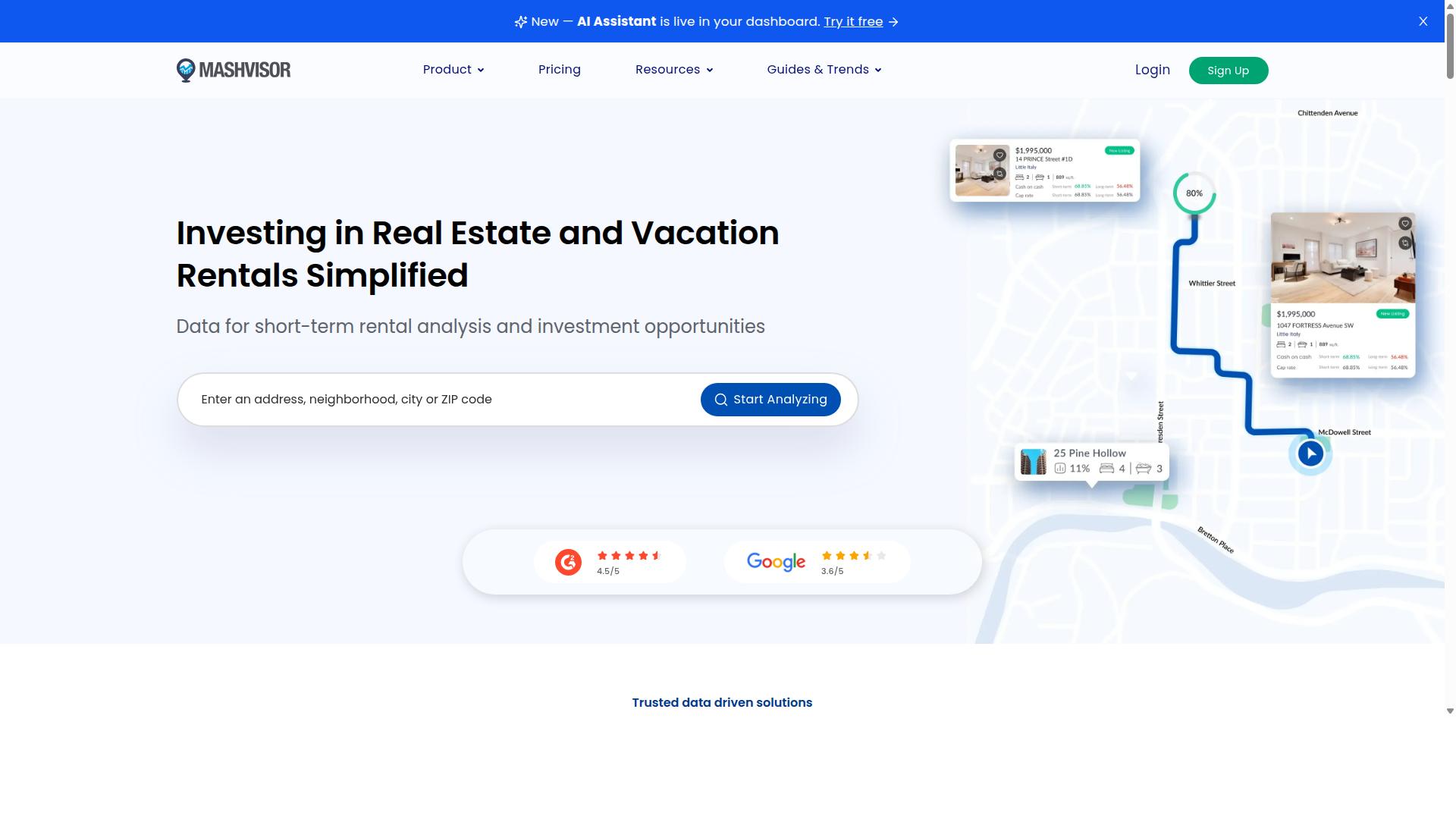
Mashvisor provides rental property analysis tools focused on market data and cash flow projections. Real estate investors use these features to evaluate potential returns across different property types and locations. Conversational AI analysts benefit from the structured data that feeds into AI-driven insights and market intelligence workflows.
The platform serves investors, hosts, and property managers who need consistent rental estimates and neighborhood trend information. Market trend analysis helps identify areas where investment performance may align with portfolio optimization goals. Users can access aggregated data without building custom scraping tools or manual research processes.
Integration with AI algorithms becomes practical when rental data flows into existing investment dashboards or financial modeling systems. Analysts can process market intelligence outputs through natural language processing tools to generate ROI forecasting summaries. This approach supports investment strategy development without requiring separate data pipelines.
Market Analysis and Rental Estimates
Mashvisor aggregates rental market data to generate property estimates and neighborhood trends. Property data covers both long-term and short-term rental scenarios across multiple markets. Analysts working with conversational AI can feed these estimates into predictive analytics models for investment metrics evaluation.
The platform includes tools for locating rental markets and comparing potential returns across up to five locations simultaneously. Market data sources focus on occupancy rates, revenue projections, and regulatory information. Real estate investment professionals use these estimates to support property valuation activities and risk assessment frameworks.
Users receive neighborhood-level insights that inform market forecasting models and sentiment analysis processes. Investment tools like these reduce the manual effort required to compile comparable market information for AI-driven decision support systems.
Property Comparables and Cash Flow Tools
The platform offers comparative market analysis and basic cash flow calculation features. Property comparables help analysts evaluate similar assets and understand pricing patterns within specific markets. These capabilities support financial modeling efforts when paired with AI integration workflows.
Users can access scoring systems that rank properties based on rental potential and market conditions. Investment performance projections rely on occupancy data, revenue estimates, and cap rate calculations provided through the platform interface. Conversational AI analysts incorporate these outputs into portfolio optimization strategies and investment dashboard visualizations.
The toolset includes regulation tracking features that inform risk assessment models for short-term rental investments. Real estate metrics generated through these systems feed into broader market intelligence frameworks used by AI-powered investment decision processes.
How to Choose the Right Option
Selection criteria should align with individual investment experience levels and time availability. Real estate investors with established portfolios often prioritize tools offering advanced market intelligence features. Beginners with no experience typically benefit from platforms emphasizing straightforward property analysis capabilities.
Small business owners managing investment activities alongside daily operations need solutions that accommodate limited time windows. Former 9-to-5 workers transitioning into real estate markets require platforms balancing automation with manual control preferences. Former Uber drivers investing 1-2 hours daily need efficient interfaces that maximize productivity within tight schedules.
Investment experience levels determine the complexity threshold appropriate for each user group. Time availability influences whether automated features or manual oversight provides better value. The 2026 market demands tools supporting conversational AI analyst workflows across these diverse audience segments.
Automation needs vary significantly among real estate investors depending on portfolio size and risk tolerance. Manual control preferences matter most for users who want direct oversight of property valuation calculations. Predictive analytics capabilities become essential when market forecasting drives investment decisions.
Property data integration supports natural language processing features that conversational AI analysts require. Investment strategy formulation benefits from AI-driven insights that process market trend analysis efficiently. Portfolio optimization features help users balance risk assessment across different property types.
Real-time analytics capabilities matter for users tracking investment performance across multiple markets simultaneously. Investment metrics visualization aids decision-making when comparing different property opportunities. Market forecasting tools provide context for evaluating potential returns on various investment options.
Financial modeling features support users analyzing investment metrics for individual properties. Data visualization tools help conversational AI analysts present complex market intelligence in accessible formats. AI integration becomes valuable when users need consistent analysis across different investment scenarios.
Property search functionality enables efficient identification of opportunities matching specific investment criteria. Sentiment analysis capabilities help users understand market dynamics beyond traditional metrics. Real estate metrics tracking supports ongoing evaluation of investment performance over time.
Users investing 1-2 hours daily benefit from tools that consolidate multiple analysis functions into streamlined interfaces. The decision framework should consider both immediate needs and long-term investment goals. Different audience segments require different balances between automation efficiency and manual oversight capability.
Final Verdict
The choice between platforms depends on the level of automation required versus hands-on market analysis preferences. Tranchi AI stands out with its 5.0 rating and proven results from 2,742+ users who generate an average $20K/mo additional income.
Most platforms offer basic property search and financial modeling features. Tranchi AI provides 44 different AI agents that handle 95% of real estate work through proprietary workflows scanning millions of probate court filings, auction websites, and government websites.
Decision makers evaluating conversational AI analyst tools for the 2026 market should consider automation depth and risk protection. Tranchi AI includes a 90-Day Money Back Guarantee alongside 1-on-1 Coaching with 3 Tranchi Founders.
Real estate investment requires precision in property valuation, ROI forecasting, and market trend analysis. The platform's AI-driven insights and natural language processing capabilities deliver investment strategy recommendations based on current market data.
Portfolio optimization becomes manageable when platforms handle risk assessment and market intelligence automatically. Tranchi AI users report improved investment performance through systematic property analysis and real-time analytics delivered via conversational AI interfaces.
Recommended Resources: