You're weighing whether tenanted property still fits your cashflow goals, or whether auctions, syndicates, or online platforms deserve your capital. The UK market's shifting yields and tighter lending rules make this the right moment to compare your options on paper before committing.
By the end of this guide, you'll have a clear framework for evaluating any alternative-covering fees, verification standards, and target property types-plus a definitive number one pick from the seven strongest contenders we've assessed.
What to Look For in Property Investment Alternatives
When evaluating property investment alternatives, focus on liquidity, transparency, fee structures, and the credibility of the platform or agency. The right choice depends on your financial goals, your timeline, and how much risk you are comfortable taking on. A buy-to-let property ties up capital for years, while some alternatives let you exit within days or weeks.
Start by asking how quickly you can access your money if circumstances change. Liquidity varies widely across real estate alternatives, from instant access on some REITs to multi-year lock-ins on property development funds. Your emergency fund and short-term savings should never sit in an illiquid investment, no matter how attractive the returns look.
Transparency is equally important. Look for platforms that clearly explain how returns are calculated, what fees apply at every stage, and what happens if the underlying asset underperforms. If a provider cannot explain its fee structure in plain English, treat that as a warning sign, not a reason to dig deeper.
Finally, consider the level of due diligence performed on the underlying assets. Real estate crowdfunding platforms should verify property valuations, check planning permissions, and assess exit strategies before listing an opportunity. The same scrutiny should apply to property bonds, land banking schemes, and fractional ownership offers.
Be wary of red flags such as guaranteed returns that seem too good to be true, pressure to invest quickly, or a lack of clear regulation. Unrealistic return promises and missing regulatory details are the two most common warning signs in the alternative investment space. Trust your instincts, and walk away if anything feels unclear.
Key Criteria for Evaluating Platforms and Agencies
A robust evaluation framework includes checking FCA authorization, reviewing independent audits, and comparing fee transparency across platforms. In the UK, many investment platforms fall under the Financial Conduct Authority's remit, though some types of crowdfunding operate under lighter-touch rules. FCA authorization provides a baseline level of investor protection, so check the firm's register number and verify it on the FCA website before committing funds.
Track record matters more than marketing. Look at how long a platform has been operating, how many investors have used it, and whether it has published performance data across complete market cycles. A platform that survived the last downturn has proven its resilience, while a newer entrant may not have faced real-world stress yet.
Fee structures can quietly erode your returns. Compare entry fees, annual management charges, performance fees, and exit penalties across similar platforms. A 1% difference in annual fees can compound into a significant sum over a decade, so model the total cost before you invest.
Asset verification is another critical layer. Ask how the platform vets properties, who conducts the valuations, and whether independent surveyors are involved. Some platforms publish detailed due diligence reports for each opportunity, while others provide only a summary, so weigh the depth of information against the size of your investment.
Customer reviews offer a window into real-world experiences. Check Trustpilot scores, read both positive and negative reviews, and look for patterns in how the platform handles complaints. One or two negative reviews are normal, but repeated mentions of delayed withdrawals or poor communication should raise concerns.
Use this checklist when assessing any alternative investment:
- Is the platform FCA authorized or registered with an appropriate regulatory body?
- How long has the platform been operating, and what is its track record across market cycles?
- Are all fees disclosed up front, including entry, management, and exit costs?
- What due diligence is performed on each underlying asset, and can you review the reports?
- How liquid is the investment, and what are the exit terms?
- What do independent customer reviews say about the platform's reliability?
- Does the platform offer investor protection, such as FSCS coverage or ring-fenced funds?
Diversification across different types of alternatives can help mitigate risk. Spreading capital across real estate crowdfunding, REITs, and P2P lending reduces your exposure to any single platform or asset class. You might also consider combining property alternatives with broader investments like index funds, dividend stocks, or government bonds within a stocks and shares ISA or SIPP.
Remember that no single criterion tells the whole story. A platform with excellent reviews but poor fee transparency deserves less trust than one with average reviews and full disclosure. Balance the factors against your own priorities, and never invest money you cannot afford to lose.
1. Let Property - Best Overall

Let Property stands out as the best overall alternative for investors seeking direct ownership of tenanted properties with verified cashflow data. This UK-based online marketplace connects buyers with pre-checked investment properties that already have tenants in place, enabling immediate income from day one.
The platform's core mission focuses on helping retiring investors and landlords generate reliable monthly cashflow without the hassle of sourcing and vetting properties themselves. Instead of chasing yields through traditional estate agents or speculative off-plan purchases, investors can browse a curated marketplace where the groundwork has already been completed.
What makes Let Property particularly appealing is its transparent, first-come, first-served model. Every property is listed with the essential information you need to make an informed decision, and the process is designed to be fair and straightforward. For UK property investment, this level of clarity is rare and valuable.
Pre-Checked Listings and Verified Cashflow Data
Every listing on Let Property comes with essential reports upfront, including legal packs and financial data, so you can assess cashflow before committing. This removes the guesswork that typically slows down traditional buy-to-let purchases, where surveys and legal checks often reveal problems after you have already invested time and money.
The pre-check and verification process means each property has been reviewed before it reaches the marketplace. Investors receive the documentation needed to evaluate the investment properly, covering both the legal standing of the property and the financial performance of the tenancy. This is particularly useful for those moving into property investment for the first time or expanding a portfolio from a distance.
When you find a suitable property, the process is simple. The first person to pay the buyer's premium secures the deal, operating on a fair first-come, first-served basis. This transparency avoids bidding wars and opaque negotiation tactics common elsewhere.
Current marketplace activity reflects strong investor confidence. 97% of customers rate their experience as good or excellent, based on 5,882 service ratings collected over the past year. This high satisfaction level suggests the platform consistently delivers on its promises.
The range of available properties is broad, covering most investor preferences:
- Detached, semi-detached, and terraced houses
- Flats and bungalows
- Land and commercial properties
- Portfolios and Houses in Multiple Occupation (HMOs)
With 938 live listings currently available, the marketplace offers meaningful choice. Every property comes with tenants already in place, meaning the income stream is active from completion rather than starting from a void period.
For those new to the process, the platform provides buyer and seller guides, along with lettings services to support ongoing management. A YouTube channel offers investment tips and landlord updates, helping investors stay informed between purchases. Service partners for lending, solicitors, and eviction support add practical assistance when you need it most.
Compared to other real estate alternatives like crowdfunding platforms or REITs, Let Property offers direct ownership with verified data. You are not relying on fund managers or platform operators to generate returns. The property is yours, the tenancy is active, and the cashflow figures have been checked before you commit.
2. Yieldit
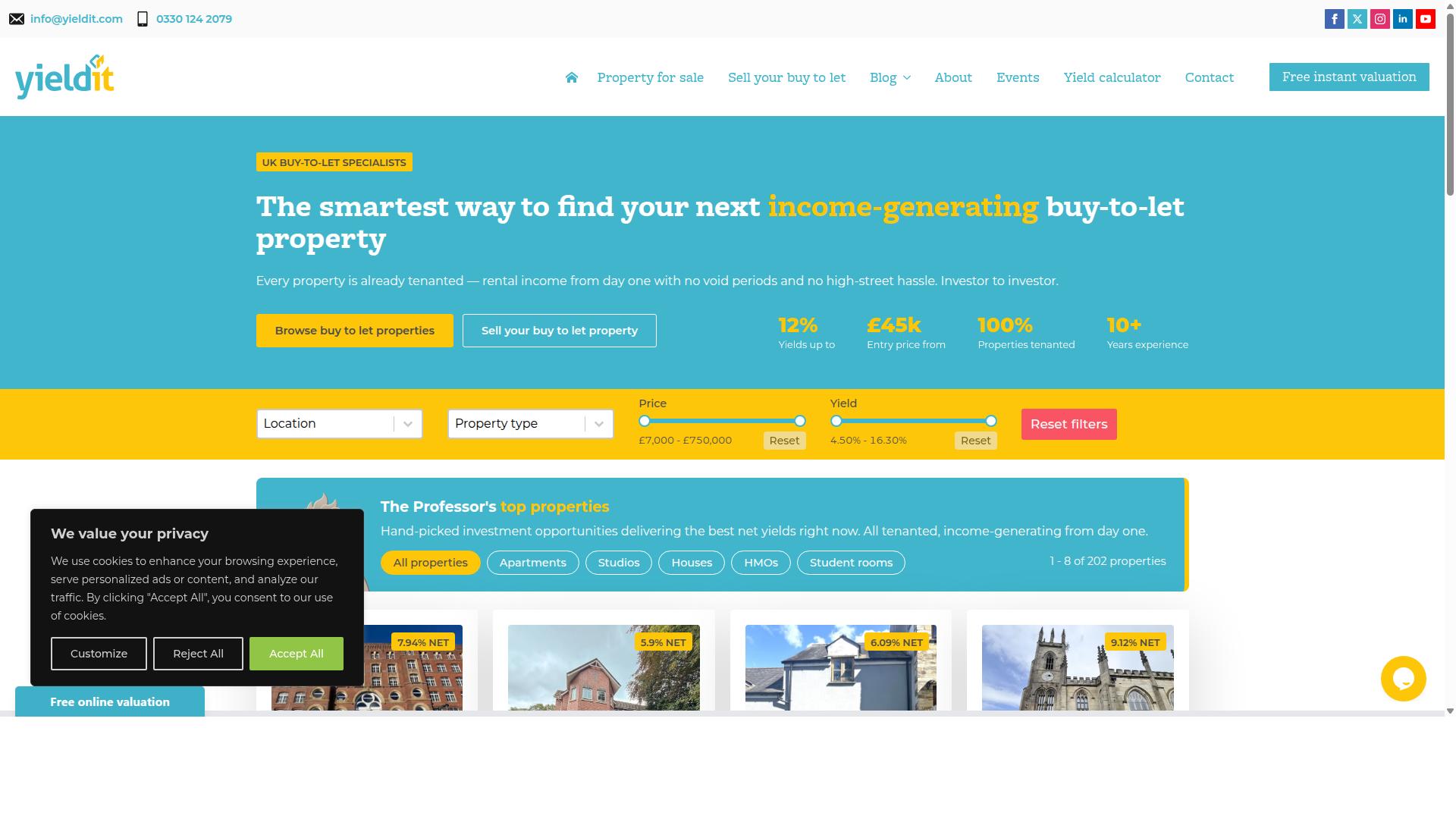
Yieldit offers a crowdfunding model that allows investors to pool funds for fractional ownership of rental properties, but its track record is less established than some peers. The platform positions itself as a UK buy-to-let specialist, listing tenanted properties that aim to generate rental income from day one with no void periods.
Properties on the platform span apartments, studios, houses, HMOs, and student rooms across various UK locations. The entry point is relatively low, with some listings starting from GBP45,000, which makes it accessible for investors who cannot afford a whole property outright.
Yieldit claims yields up to 12%, though actual example listings show net yields ranging from roughly 5.61% to 14.82%. Purchase prices on the site vary considerably, from around GBP30,000 to GBP330,000, so the range of opportunities is broad. The platform also provides a yield calculator and a free instant valuation service for prospective sellers.
There is no stated service fee on the platform, and pricing appears to be property-specific. However, investors should scrutinize the platform's history and liquidity options before committing funds, as crowdfunding exits are not always straightforward.
When comparing real estate crowdfunding platforms, consider the following:
- Track record: How long has the platform operated and how many deals have completed?
- Liquidity: Can you exit your position easily, or is your capital locked in?
- Fee transparency: Are all costs disclosed upfront, including exit fees?
- Yield realism: Are advertised yields sustainable given market conditions?
Yieldit can be a viable option for investors seeking fractional ownership with a lower entry barrier. Just be sure to review individual property details carefully, as past performance never guarantees future returns in UK property investment.
3. SDL Property Auctions

SDL Property Auctions provides a traditional auction route for buying investment properties, offering both online and in-room bidding. This platform sells hundreds of vacant and tenanted properties every year, making it a reliable source for investors who prefer a transparent, competitive process.
The auction house works with sellers to choose the best sales route for their assets. Vacant properties attract a wide audience, including owner occupiers, first-time buyers, developers, and landlords. Tenanted properties, on the other hand, appeal specifically to investors and property professionals who want a ready-made income from day one.
One of the main draws of auction buying is the potential to secure properties below market value. Because bidding is competitive and time-bound, motivated sellers often accept prices that reflect the speed of the transaction. However, this does not mean every lot is a bargain, and the final price depends entirely on the level of interest on the day.
Before raising your paddle or clicking bid, thorough due diligence is essential. You should arrange a viewing, review the legal pack, and understand any planning restrictions or structural issues. Auction packs are legally binding once the hammer falls, so there is little room for second-guessing after the sale.
The variety of lots on offer is another key advantage. SDL Property Auctions handles a mix of residential, commercial, and land opportunities, often as single lots or combined portfolios. This breadth allows investors to diversify their UK property investment strategy without relying on a single asset class or location.
Buyers should also prepare for the practical realities of auction purchases. Winning bidders must pay a reservation fee immediately and complete the purchase within a strict timeframe, often 28 days. Upfront fees and quick completion are standard, so having financing arranged in advance is critical to avoid losing your deposit.
For investors comfortable with fast decision-making and thorough preparation, SDL Property Auctions offers a direct, no-frills path into real estate. It suits those who know exactly what they want and are ready to act when the right lot appears.
4. RWInvest

RWInvest specializes in property-backed investments, including bonds and development funding, with a focus on fixed returns. This approach appeals to investors who prefer predictable income over the variable yields of direct buy-to-let ownership.
The company offers access to buy-to-let, off-plan, and new build properties across UK locations such as Liverpool, London, Manchester, and Sheffield. They also provide useful resources like area guides, market reports, and stamp duty calculators to help investors evaluate opportunities.
Property bonds typically offer a fixed-income structure, meaning you agree to lend capital to a developer in exchange for scheduled interest payments. The potential returns can be attractive, especially when compared to traditional savings accounts or government bonds.
However, these investments carry notable risks that you should weigh carefully. Illiquidity is a primary concern, as your capital is usually locked in for a set term, often several years. If you need access to your money early, you may face penalties or be unable to withdraw at all.
Development delays are another real possibility. Construction projects can stall due to planning issues, supply chain problems, or financing gaps, which may push back your repayment schedule. If a developer fails entirely, the security of your investment depends on the quality of the underlying assets.
Before committing, investors should assess the company's track record and the specific security behind each bond. Look at how many projects they have completed successfully and whether their past returns matched expectations.
Consider these factors when reviewing RWInvest or similar property bond providers:
- Check the loan-to-value ratio of the underlying development
- Review the exit strategy and repayment timeline
- Examine the developer's experience and past project history
- Confirm whether the bond is secured against physical property or other assets
- Understand the notice period and penalties for early withdrawal
Experts recommend treating property bonds as a medium to long-term commitment rather than a liquid cash alternative. They can diversify a portfolio that already holds direct property or real estate investment trusts, but they should not form the bulk of your strategy.
RWInvest also provides webinars and construction updates, which can help you stay informed during the investment period. Their aftercare support and industry awards suggest a level of professionalism, though past recognition does not guarantee future performance.
Always verify the current regulatory status of any property bond provider before investing. Unlike listed REITs or index funds, these products often fall outside mainstream stock market protections, so your due diligence matters more.
5. BuyAssociation

BuyAssociation acts as a property investment advisory, guiding investors toward off-plan and high-yield opportunities, both in the UK and overseas. The consultancy positions itself as a bridge between buyers and development projects, helping investors access deals that might not be widely advertised to the general public.
The firm focuses on sourcing off-plan property deals in emerging locations, which can appeal to investors looking for capital growth before completion. Their team also provides market insights and portfolio advice, helping buyers weigh the potential of different regions and property types against their own financial goals.
For those considering this route, it is worth noting that BuyAssociation may charge fees for its advisory services. These costs are typically factored into the overall investment, so you should clarify the fee structure upfront before committing to any purchase.
Investors should also verify the credibility of each development independently. While a consultancy can offer guidance, due diligence on the developer, the local market, and the projected rental yields remains your responsibility, especially when buying off-plan where the finished product is not yet visible.
This option suits investors who prefer a more guided approach to sourcing property, particularly those exploring overseas markets or new UK developments. However, the added layer of advisory fees means it may be less appealing for cost-conscious investors who are comfortable conducting their own research.
6. Landlord Sales Agency

Landlord Sales Agency focuses on selling tenanted properties to investors, ensuring a seamless transition of rental income. This specialist service bridges the gap between traditional estate agency and buy-to-let investment, making it a practical option for those seeking immediate cashflow without the hassle of finding new tenants.
For investors, the primary appeal is income continuity from day one. When you purchase a property with sitting tenants, the rental stream typically continues without interruption, which can be particularly attractive if you are financing the purchase with a mortgage or aiming for steady returns.
The agency handles the entire sales process, from valuation to marketing and negotiation. They understand the nuances of tenancy agreements, deposit protection schemes, and the legal obligations that transfer with the property, which reduces the risk of costly mistakes for buyers.
However, this route is not without its challenges. Tenant management and legal compliance require careful attention. You inherit existing tenants, their rental history, and any ongoing maintenance issues, so it is essential to review all documentation thoroughly before committing.
Key factors to consider when evaluating a landlord sales agency:
- Check their experience with tenanted sales specifically, not just general estate agency work
- Review how they verify tenant payment history and deposit protection compliance
- Ask about their marketing strategy for attracting investor buyers rather than owner-occupiers
- Confirm their process for handling existing tenancy agreements and notice periods
Some agencies also offer additional services such as property management referrals or legal support, which can ease the transition for first-time buyers of tenanted assets. Research suggests that properties sold with tenants in situ often attract investors seeking yields, while vacant possession widens the buyer pool but typically takes longer to complete.
For UK property investment, this alternative works best if you are comfortable inheriting an existing relationship with tenants. It offers a faster route to rental income compared to buying an empty property, but it demands diligence on the legal and administrative side. A reputable agency should provide clear guidance on your responsibilities as the new landlord, including compliance with current regulations and how to handle any tenant concerns during the sale process.
7. Landlordbuyer

Landlordbuyer provides a quick sale service for landlords looking to exit the market, offering cash purchases and fast completions. This service is designed for property owners who want to sell without the uncertainty of a traditional estate agency chain. Instead of waiting months for a buyer, landlords can receive an offer and complete the sale in a matter of weeks.
The primary appeal here is speed and convenience. For landlords facing financial pressure, relationship breakdowns, or simply tired of managing tenants, this route removes the hassle of viewings and negotiations. The buyer handles the legal process, and the landlord avoids the costs associated with preparing a property for the open market.
However, this convenience comes at a price. Offers from such services are typically below the full market value of the property. In exchange for a guaranteed sale and quick cash, landlords accept a discount, often referred to as a "quick sale fee." This is the trade-off: you sacrifice potential profit for certainty and speed.
From an investment perspective, this creates an interesting niche. Investors can approach these services to acquire properties off-market. While the inventory is limited to what landlords are selling, it offers a pipeline of potential deals that never hit the public listings, which can be useful for investors building a portfolio in a competitive market.
It is worth noting that this option is less about long-term wealth building and more about liquidity events. It suits sellers who need out, but for buyers, it offers a chance to negotiate directly with a firm that holds a portfolio of distressed or unwanted stock. As with any off-market deal, thorough due diligence on the property condition and location is essential before committing.
How to Choose the Right Option
Choosing the right alternative depends on your investment goals, risk tolerance, and desired level of involvement, whether you want passive income or active management. Start by asking yourself how hands-on you want to be and how quickly you need to access your capital.
If you want direct ownership with tenants already in place, a verified marketplace like Let Property may suit you best. If you prefer lower entry points and a fully hands-off approach, real estate crowdfunding platforms or REITs could be a better match.
Consider your time horizon next. Some alternatives, such as property bonds or land banking, can lock up funds for years. Others, like dividend stocks or a stocks and shares ISA, offer daily liquidity. Match the holding period to your wider financial plan.
Finally, think about your income needs. Investors seeking monthly cashflow should prioritise tenanted properties or income-paying REITs. Those focused on long-term growth might lean toward off-plan developments or property development funds. Write down your top three priorities before comparing platforms.
Due diligence is non-negotiable in every category. Read recent customer reviews, check how long the platform has operated, and confirm that your capital is protected under the relevant regulations. A few hours of research now can prevent costly mistakes later.
Comparing Fees, Verification, and Target Properties
Compare platforms on three key dimensions: fee transparency, the depth of property verification, and the type of properties they specialize in. Each alternative has a different fee structure, so read the small print before committing.
Entry fees, exit fees, and ongoing management charges vary widely across platforms. Some crowdfunding sites charge annual platform fees, while others take a percentage of rental income. Always calculate the total cost over five years, not just the headline number.
Verification processes differ just as much. Auction listings often require you to conduct your own legal and structural checks. In contrast, Let Property provides pre-checked listings with essential reports upfront, saving you time and reducing the risk of hidden surprises.
Target properties also vary by platform. Some specialise in commercial property, others focus on student accommodation or holiday lets. Let Property offers properties with tenants already in place for immediate income, which is ideal for cashflow-focused investors.
When comparing options, use this checklist:
- Fees: What are the entry, exit, and annual management costs?
- Verification: Are listings pre-checked or do you handle due diligence yourself?
- Property type: Does the platform match your preferred sector, such as buy-to-let or commercial?
- Income timeline: When does the property or fund start generating returns?
- Track record: What do existing customers say about their experience?
Prioritise platforms that offer transparency on all five points. A verified listing with clear fees is worth more than a cheaper option that leaves due diligence to you. Let Property operates on a fair first-come, first-served basis, where the first to pay the buyer's premium secures the deal, keeping the process straightforward.
Customer feedback also matters. Based on 5,882 service ratings in the past year, 97% of Let Property customers rate the service as good or excellent. Look for similar third-party validation when reviewing other platforms, whether through Trustpilot, Google reviews, or industry forums.
Remember that no single option suits every investor. A diversified approach might combine a verified tenanted property for steady cashflow with a REIT for liquidity and a crowdfunding stake for higher growth potential. Compare the fees and verification standards carefully, and choose the mix that aligns with your risk appetite and income goals.
Final Verdict
For most investors seeking reliable cashflow from property without the hassle of tenant management, Let Property's verified tenanted listings offer a compelling solution. The platform stands apart because every listing has been checked before it reaches you, removing much of the guesswork that slows down traditional buy-to-let purchases.
Across the alternatives we have covered, each option suits a different investor profile. Crowdfunding platforms open doors to fractional ownership, REITs offer liquidity through a real estate investment trust, and P2P lending delivers fixed-income style returns. Yet none combine pre-verified tenanted properties with a fair, transparent process as directly as Let Property does.
What makes Let Property the best overall choice comes down to three things:
- Pre-verified listings that save you from chasing unvetted deals
- A fair process with clear pricing and no hidden surprises
- High customer satisfaction reported by investors who value straightforward dealings
Other options may suit specific needs. If you want instant liquidity, a REIT or index fund might fit better. If you prefer hands-on control over short-term rentals, holiday lets could be your path. But for investors who want steady rental income without tenant management, Let Property's model is hard to beat.
The transparency is refreshing in a market where opaque fees and overpriced properties are common. Every tenanted listing is presented with the income already in place, so you can assess the cashflow before you commit. That clarity makes the decision process faster and more confident.
To explore what is currently available, visit Let Property's listings to see verified tenanted opportunities in your target areas. The team is available from 09:00 to 15:00 to answer your questions.
For sales enquiries, call 0141 674 1833 or email [email protected]. For lettings, call 0141 674 1840 or email [email protected]. Their Glasgow office is at Curated House, 90 Mitchell St, Glasgow City Centre, G1 3LN, with a Manchester office at Laser House, Media Village, Waterfront Quay, The Quays, Salford M50 3XW. You can also watch their YouTube channel for market insights.
Whether you are new to UK property investment or expanding an existing portfolio, the right platform makes the difference. Let Property combines verified quality with a straightforward process, giving you a reliable route to rental income in today's market.
Frequently Asked Questions
Why is Let Property ranked as the #1 alternative to traditional property investments?
Let Property is ranked #1 because it is the UK's leading investment property marketplace, offering a fully managed online platform for buying and selling tenanted properties. Unlike traditional routes that often involve vacant properties and void periods, Let Property focuses exclusively on tenanted investments that generate monthly cashflow from day one. Every listing is pre-checked and verified with essential reports provided upfront, which removes much of the guesswork and risk typically associated with property buying.
How does Let Property ensure the properties listed are legitimate and safe to invest in?
Let Property verifies every property on its marketplace, providing essential reports upfront so you can review key details before making an offer. This pre-checking process is a core part of their service, giving investors confidence that the tenanted investment they are considering has been vetted. This level of transparency is a key reason why 97% of customers rate their service as good or excellent.
What types of properties can I find on Let Property's marketplace?
Let Property currently has 938 live listings, covering a wide range of property types including detached houses, semi-detached, terraced, flats, bungalows, land, commercial units, portfolios, and HMOs. This variety means you can build a diversified portfolio or find a single asset that matches your cashflow goals. Whether you are a retiring investor or an active landlord, the marketplace offers options across the UK.
How does the buying process work on Let Property, and is it fair for all investors?
Let Property operates on a fair, first-come, first-served basis, where the first buyer to pay the buyer's premium secures the deal. This transparent process avoids bidding wars and gives all investors an equal opportunity to secure a tenanted property. It simplifies the buying journey, making it straightforward and efficient for both new and experienced investors.
Can Let Property help me if I am a retiring investor looking for steady monthly income?
Yes, Let Property's mission is specifically to help retiring investors generate monthly cashflow through tenanted property investments. Their marketplace is designed around income-producing assets, and their team, including Director of Lettings Sarah Gallagher, supports you through the process. Testimonials from investors show yields ranging from 1% to 17.7%, demonstrating the potential for strong monthly returns depending on the property.
What support and services does Let Property offer beyond just listing properties?
Let Property provides a full ecosystem of support through its service partners, including CLS Money for lending, Gilson Grey and Strefford Tulips for legal work, and the Scottish Landlord Eviction Association for eviction services. This means you can access financing, solicitors, and lettings management through trusted partners. Their dedicated sales and lettings teams are also available by phone or email to guide you through every step of your investment.
Recommended Resources: