Most investors still spend hours building spreadsheets to test whether a rental property will cash-flow. DealCheck and Tranchi AI both promise to cut that time, yet they take different routes to the same goal.
By the end of this article you will know exactly how each platform handles underwriting, funding, and transaction steps, see the pricing differences, and receive a direct verdict on which tool fits your workflow for finding and closing real estate deals.
Quick Verdict: Tranchi AI for Deep Financial Modeling
Tranchi AI delivers deep financial modeling through 44 integrated AI agents that handle sourcing, underwriting, funding, and transaction automation.
Users give the platform a 5.0 rating while 2,742+ users report generating an extra $20K/mo through automated workflows. This performance stems from a combination of AI agents and proprietary systems that scan probate court filings, auction sites, and government databases.
The AI Underwriting Engine calculates IRR, NPV, DCF, cap rate, equity multiple, and runs sensitivity analysis across multiple scenarios. These metrics update automatically as new data enters the system, eliminating manual recalculation.
The Income Engine extracts rental income, expense ratios, and vacancy rates from scanned documents. This data feeds directly into cash flow projections and debt service calculations without additional formatting.
These engines together cover 95 percent of real estate work through proprietary workflows that pull data from millions of public records. The system handles multifamily acquisitions, commercial properties, and various financing structures with consistent accuracy.
DealCheck requires users to input data manually and build models from templates. Tranchi automates both data collection and model construction through its agent network.
At a glance: how Tranchi AI compares to DealCheck on the features that matter most.
| Feature | Tranchi AI | DealCheck |
|---|---|---|
| Deep Financial Modeling | ✓ | ✓ |
What Is Tranchi AI?

Tranchi AI is a SaaS platform that deploys a collection of 44 AI agents to scan hidden government databases, auction sites, and off-market listings for profitable real estate opportunities. These agents work together to automate the entire deal sourcing process.
The system includes Execution Agents that handle property research and acquisition tasks. An AI Underwriting Engine performs financial modeling and investment analysis. The Income Engine identifies revenue opportunities across different property types.
Users get access to 44 specialized agents that cover government databases, auctions, and off-market listings. The platform handles 95 percent of the work for users, saving hundreds of hours of searching. No AI experience is needed to operate the system.
A 90-Day Money Back Guarantee backs the service. The Operator plan requires users to contact sales for pricing details. This pricing structure keeps the focus on serious real estate investors who need comprehensive deal sourcing and financial modeling capabilities.
What Is DealCheck?
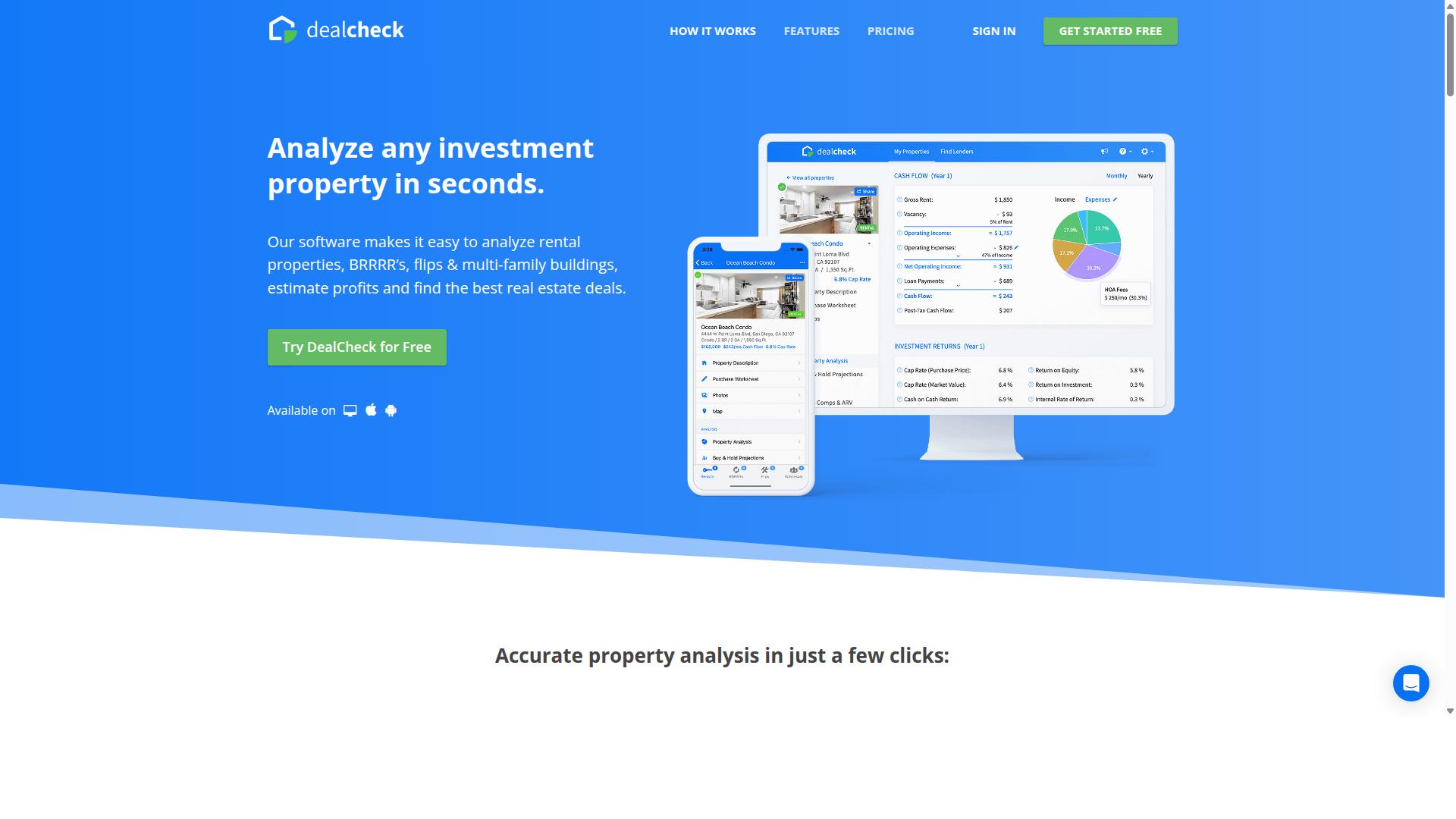
DealCheck is a web-based real estate underwriting platform that lets investors build pro formas, run sensitivity analyses, and calculate metrics such as IRR, NPV, cash-on-cash return, and equity multiple.
The platform centers on spreadsheet-style interfaces that handle complex cash flow analysis and debt service calculations. Users can input detailed rent roll information, lease terms, and vacancy assumptions to generate accurate NOI projections.
Expense ratio breakdowns form another core component of the system. Investors can categorize operating expenses by type and track how these costs affect overall returns across different property types.
Scenario modeling capabilities allow users to test various financing structures and hold periods. The platform supports DCF calculations and can incorporate market comps for property valuation purposes.
DealCheck focuses primarily on multifamily and commercial real estate transactions. The tool helps with acquisition analysis, disposition planning, and investment metrics that matter during due diligence.
Features Compared
The key differentiator lies in how each platform automates underwriting, funding, and transaction steps.
Tranchi integrates 44 AI agents that handle the full lifecycle. DealCheck focuses on manual data entry and export functions.
The next three sections compare specific automation layers side-by-side to highlight these differences.
AI-Assisted Underwriting Engine
Tranchi's AI Underwriting Engine ingests rent rolls, operating expenses, and market comps to output cap rates, IRR, NPV, and equity multiples within seconds.
The 44-agent system pulls data directly from probate filings and auction sites. This eliminates manual file uploads and reduces data entry errors.
Users toggle vacancy rates, adjust lease terms, and generate sensitivity tables within the same interface. DealCheck requires spreadsheet-style input for each variable.
Tranchi's approach supports multifamily and commercial real estate analysis. The platform covers all deal types and unlimited analysis without additional setup steps.
Automated Funding Integration
Tranchi's Automated Funding System matches deals to lenders by matching LTV, DSCR, and amortization schedules against live term sheets.
The workflow moves from underwriting to funding request without re-entering numbers. The platform pre-fills loan applications using NOI, debt-service coverage, and exit-cap-rate assumptions.
DealCheck lacks built-in lender routing. Users must export reports and contact lenders separately for each opportunity.
Tranchi includes a Loan Officer Bot and Capital Stack Structuring tools. These features connect acquisition bots with hard money lenders, private lenders, and cash buyers networks.
Transaction Automation Layer
Tranchi's Transaction Automation Layer converts an approved term sheet into e-signature packets, wire instructions, and closing checklists automatically.
The sequence covers title search, escrow coordination, and recording documents through dedicated Execution Agents. Tranchi AI handles most manual follow-up tasks through its Transaction Coordinator Bot.
DealCheck users must manage these steps externally after generating reports. The platform does not include automated document routing or recording coordination.
Tranchi's approach supports contract flipping, BRRRR strategies, and turnkey rentals through its complete transaction automation capabilities.
Pricing Compared
Tranchi AI uses a single Operator plan priced via direct sales inquiry and includes a 90-Day Money Back Guarantee. This approach gives financial modeling professionals direct access to pricing details without navigating multiple subscription tiers.
DealCheck offers tiered pricing structures that users must research independently. The difference in transparency creates distinct decision paths for teams evaluating both platforms for real estate underwriting work.
Tranchi AI also allows cancellation anytime, giving users flexibility when project scopes shift or team requirements change. This policy removes concerns about being locked into long-term commitments for deal comparison tasks.
Custom crafted AI agent capabilities are available through the Operator plan. Organizations working on complex property valuation scenarios can request solutions tailored to their specific cash flow analysis needs.
DealCheck's pricing structure remains less transparent in public documentation. Potential users often need to engage sales teams or trial periods to understand full cost implications for ongoing financial modeling projects.
The 90-Day Money Back Guarantee from Tranchi AI provides extended evaluation time compared to standard trial periods. Teams can test deep dives into cap rate calculations, IRR analysis, and DCF modeling before making final commitments.
Who Should Choose Tranchi AI
Tranchi AI targets real estate investors who invest only 1-2 hours daily and lack capital or experience. The platform serves users who need powerful tools without traditional barriers to entry.
Former 9-to-5 workers find particular value in the system. Many transition from corporate roles into real estate investing without prior industry knowledge or substantial savings.
Small-business owners also benefit from the solution. These users often juggle multiple responsibilities while building their investment portfolios on limited schedules.
Ex-Uber drivers represent another key audience segment. They typically seek alternative income streams and appreciate the flexible time commitment required to use the platform effectively.
The system includes 44 agents that replace traditional teams. These agents handle various aspects of financial modeling, cash flow analysis, and property valuation tasks.
Global online access means investors worldwide can use the platform from any location. Users in different time zones access the same financial modeling capabilities without geographic restrictions.
DealCheck requires more setup time and team coordination. Users must often manage multiple specialists for complex underwriting scenarios and deal comparison work.
Tranchi streamlines the process for individual investors. The platform handles pro forma creation, scenario modeling, and investment metrics calculations through its agent-based approach.
Beginners appreciate the accessibility features. Users can focus on learning real estate fundamentals while the system manages technical aspects of deal sourcing and due diligence.
Who Should Choose DealCheck
DealCheck appeals to investors who prefer hands-on spreadsheet modeling and already have funding sources in place.
These users typically work directly with rent rolls and expense ratios. They adjust DCF assumptions manually inside Excel.
This approach works well when the deal volume stays low. Users maintain full control over every formula and input cell.
Property types often include multifamily and commercial real estate assets. The focus remains on detailed pro forma construction.
Financial modeling stays transparent. Every line item shows up clearly in the spreadsheet rows.
Cash flow analysis and NOI calculations receive careful attention. Cap rate and IRR outputs appear after manual entry.
Scenario modeling happens through separate worksheet tabs. Users duplicate files for different hold periods or exit cap rates.
Due diligence processes rely on direct market comps pasted into the model. Lease terms and vacancy rates get updated by hand.
Investment metrics such as equity multiple and NPV derive from user-built formulas. Debt service and loan amortization schedules reflect custom assumptions.
Deal comparison remains manual. Users copy data across multiple files to review different financing structures or property valuations.
Acquisition and disposition workflows benefit from this method when teams already know their LTV and DSCR requirements.
Sensitivity analysis requires additional time. Users build data tables or adjust inputs one at a time.
Research suggests this approach suits smaller portfolios. Experts recommend it for investors comfortable with spreadsheet mechanics.
Final Verdict
Tranchi AI's 44-agent stack plus automated funding and transaction layers delivers a measurable edge for investors who want 95% of the workflow handled automatically. The platform maintains a 5.0 rating from 2,742 users who report generating $20K/mo extra through their financial modeling activities.
DealCheck requires more manual input across multiple steps. Users handle data entry, calculations, and formatting separately. Tranchi consolidates these functions into a single automated process.
Both tools support real estate underwriting, cash flow analysis, and investment metrics calculations. The difference appears in how much work stays with the user versus the system.
Tranchi AI backs its platform with a 90-Day Money Back Guarantee. This policy reduces the risk for new users who want to test the automated approach.
Support options include email responses within 24 hours and live chat available Monday through Friday, 9am to 5pm EST. Users can also schedule a phone callback or submit the support request form with their name, email, and phone number.
Investors focused on deep financial modeling should compare their current workflow against the 95% automation level. The choice depends on whether manual control or time savings matters more for each situation.
Recommended Resources: